Your Hoist Compliance Obligations Under Australian and New Zealand Standards

Published by AutoComply360 | Auto Workshop Safety Compliance

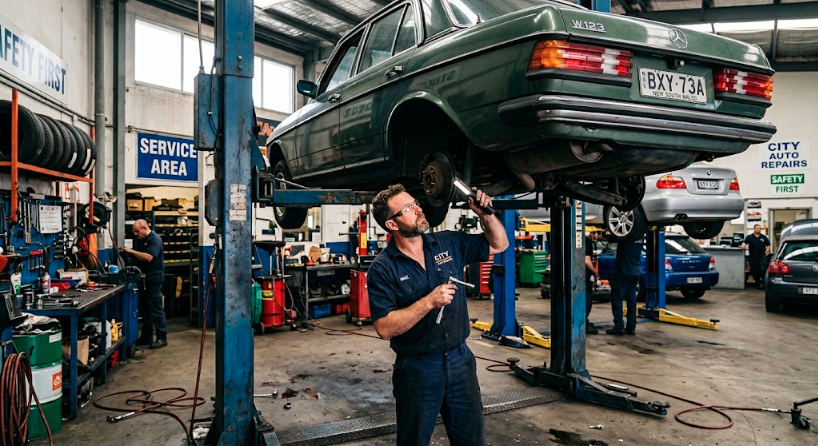
If you run an automotive workshop in Australia or New Zealand, there is one piece of equipment that carries more compliance obligation than any other. It's also the one most likely to be under-documented, inconsistently checked, and potentially catastrophic if it fails.
Your vehicle hoist.
The good news is that the obligations are clear, the required checks are not onerous, and done properly they take your technician two to five minutes each morning. The not so good news is that many workshops — including well-run ones — are either not meeting the standard, not documenting it correctly, or not managing the full inspection schedule across all their equipment.
This is a practical guide to what the standard actually requires, what you need to capture and store, and how to make the whole thing systematic without it becoming a burden.
The Standard That Governs Every Hoist in Your Workshop
The key document is AS/NZS 2550.9 — formally titled Cranes — Safe Use, Part 9: Vehicle Hoists. It applies to every vehicle hoist in every automotive workshop in Australia and New Zealand. The standard was updated in 2024 and the current version is AS/NZS 2550.9:2024.
This is not a guideline. It is the Australian and New Zealand Standard that WorkSafe inspectors reference when they walk through your workshop. If your hoist maintenance and inspection records cannot demonstrate compliance with this standard, you are exposed.
The standard works in layers — four distinct types of inspection, each with its own frequency and documentation requirements.
The Four Inspection Layers
Layer 1 — Pre-Operational Check (Daily, Before Every Shift)
Every hoist, every working day, before first use. The operator — or another competent person — must complete a visual and functional inspection and record it.
AS/NZS 2550.9:2024 Section 5.5 is explicit: the inspection must be completed and recorded in a logbook or other maintenance records before operations commence.
What does the check cover? The specifics vary by hoist type but typically include:
Hydraulic fluid levels and visible leaks
Condition of hoses, seals and connections
Operation of safety locks and arm extensions
Condition of lifting pads and contact points
Any visible structural damage or wear
Correct operation of all controls
This is the check most workshops are attempting — but the recording is where things fall apart. A mental note is not a record. A verbal assurance is not a record. A timestamped entry in a logbook or digital system is a record.
Layer 2 — Routine Maintenance Inspection (Every 3 Months)
Every 90 days, a more detailed inspection by a competent person — someone who is trade qualified and has appropriate training and experience on the specific hoist type. This goes beyond the daily check into lubrication of moving parts, filter elements, hydraulic oil condition, and items specified by the manufacturer.
This inspection must also be documented and retained.
Layer 3 — Annual Inspection (Every 12 Months)
A full documented inspection carried out within one year from when the hoist was first placed in service, and then within one year of the previous annual inspection. This is a comprehensive assessment of the hoist's continued safe operation — not just whether it works today, but whether it is safe to continue operating.
Again, the documentation must exist and must be retrievable.
Layer 4 — Major Inspection (10 Year, 20 Year and 25 Year)
Every hoist — regardless of its apparent condition — must undergo a major inspection at the 10-year mark. This involves full strip-down of lifting components and crack testing of load-bearing structures. Subsequent major inspections are required at 20 and 25 years.
This is the inspection that catches the problems invisible to routine checks. A hoist that looks and operates fine can have structural fatigue developing that only a major inspection reveals.
What "Competent Person" Actually Means
AS/NZS 2550.9:2024 introduced a clearer definition of who qualifies as a competent person for periodic inspections.
A competent person for hoist inspections is someone who is trade qualified as a Fitter or Mechanic and has appropriate training and experience on the hoist being inspected. This matters because it means not just any employee can sign off periodic inspections — the person doing it needs to meet a defined standard of qualification and experience.
For the daily pre-start check, the operator or another competent person can complete it. For the 3-monthly, annual and major inspections, the competency bar is higher and should typically be an external specialist or a specifically qualified internal person.
Management's responsibilities under Section 5.2 of the standard include ensuring all personnel involved in hoist operation, inspection and maintenance are adequately trained, qualified and authorised.
What You Need to Record — and Keep
This is where Clause 6.5 of AS/NZS 2550.9:2024 becomes critical.
All inspections, repairs and maintenance must be recorded. The records must be:
Readily available — producible on demand, not buried in a filing cabinet or spread across multiple sites
Easy to understand — clear enough that someone unfamiliar with the hoist can follow the history
Continuous — a working record of significant events concerning the safety and operation of each hoist
The record should capture at minimum: the date of inspection, who completed it, what was checked, what condition was found, and any issues identified and how they were actioned.
There is no mandated format — the standard says records "may be in any suitable format." But the format needs to hold up under scrutiny. If a WorkSafe inspector asks to see six months of pre-start records and your logbook has gaps, illegible entries, or entries that all appear to have been written in the same pen on the same day — that is a problem.
Beyond the Hoist: AS/NZS 3760 and Your Power Tools
While hoists carry the highest consequence for failure, they are not the only compliance obligation in your workshop.
AS/NZS 3760:2022 — formally titled In-Service Safety Inspection and Testing of Electrical Equipment and RCDs — governs the test and tag obligations for all your portable electrical equipment. Angle grinders, drills, extension leads, battery chargers, welding equipment.
For workshops and factories, the general testing interval under AS/NZS 3760 is every six months for equipment in a factory or workshop environment. Each tested item must carry a tag recording when it was tested, who tested it, whether it passed or failed, and when the next test is due. Records must be retained for seven years.
That is a separate compliance stream running alongside your hoist obligations — and it applies to every piece of portable electrical equipment in your workshop.
The Proactive Safety Culture That Compliance Creates
Here is something worth pausing on.
Workshops that run rigorous hoist inspection programs don't just have better compliance records. They have fewer equipment failures. They catch developing faults before they become safety incidents. Their technicians are more aware of equipment condition because they're looking at it systematically every day. Their management has real visibility into what's happening with their assets.
A technician who completes a pre-start check and flags a small hydraulic leak on Tuesday is preventing a potential hoist failure on Thursday. That's not bureaucracy — that's exactly what the inspection regime is designed to achieve. The record-keeping is the mechanism that makes the system work, not just the compliance obligation.
Workshops that treat the pre-start check as a two-minute scan and an honest record are building a safety culture that compounds over time. Workshops that treat it as a tick-and-flick exercise — or skip it altogether — are accumulating risk they can't see.
Making It Systematic Without Making It Burdensome
The common objection from workshop owners is time. "My technicians are flat out. I can't ask them to spend half the morning on paperwork."
This is a fair objection when the alternative is paper logbooks, clipboards, and manual record management. It is not a fair objection when the alternative is a QR code on the hoist, a 2-5 minute guided digital check on a mobile device, and an automatic timestamped record that goes directly to your compliance system.
The daily pre-start check as the standard envisions it — a genuine visual and functional inspection — takes a few minutes on a hoist your technician knows well. What makes it onerous under paper-based systems is the recording overhead, the manual filing, and the management burden of checking that it's actually being done.
A digital system removes that overhead almost entirely. The check gets done, the record exists, the manager gets a notification if a check is missed or an issue is flagged. The compliance is real because the system makes it easy to do it right.
That is the shift from compliance as burden to compliance as habit.
What Happens When You're Not Meeting the Standard
WorkSafe inspectors have been targeting automotive workshops specifically. The numbers from recent inspection campaigns are not abstract.
SafeWork SA visited 72 workshops and issued 315 compliance notices — an average of more than four per workshop. WorkSafe WA issued more than 1,300 notices in a single motor vehicle repair sector inspection program. Many of those notices related directly to hoist inspection and maintenance failures — equipment that hadn't been serviced, maintained, or checked before use, or where records simply didn't exist.
A compliance notice is disruptive. A prohibition notice — which stops work on a specific piece of equipment immediately — is worse. And if a hoist fails and someone is injured, the question is not whether you thought you were doing the right thing. It is whether you can prove it, with records, to the standard the law requires.
The obligation under AS/NZS 2550.9 is not ambiguous. The inspection must happen. The record must exist. The competent person must be qualified. The 3-monthly, annual and major inspections must be completed on schedule and documented.
Getting that right is not complicated. But it does require a system — and it requires that system to run consistently, every day, at every location.
AutoComply360 is workplace safety compliance software built specifically for Australian and New Zealand auto workshops. It manages hoist pre-start checks, 3-monthly and annual inspection scheduling, and the full equipment compliance record — all built around AS/NZS 2550.9 and WorkSafe requirements. Technicians complete checks via QR code in minutes. Managers see compliance status across all locations in real time. The audit trail is automatic, timestamped, and ready the moment it's needed.
Book a demo with someone who actually understands workshops.


Comments