What WorkSafe Inspectors Actually Check in Auto Workshops

Published by AutoComply360 | Auto Workshop Safety Compliance

Here's something worth thinking about on a quiet Tuesday morning.
A WorkSafe inspector walks through your workshop door. No warning. No appointment. They have the legal right to do exactly that — and they do it regularly across automotive workshops all over Australia.
What happens next depends entirely on what you've been doing when nobody was watching.
The PCBU — That's You
Before we get into what inspectors check, it's worth understanding the legal position you're standing in as a workshop owner or operator.
Under the Work Health and Safety Act 2011, you are what's called a PCBU — a Person Conducting a Business or Undertaking. That title comes with a primary duty of care to ensure, so far as is reasonably practicable, the health and safety of your workers and anyone else at your workplace.
The critical word in that sentence is ensure. Not intend. Not try. Ensure.
And here's the part that catches a lot of workshop owners off guard: when something goes wrong — or when an inspector arrives — the burden of proof sits with you. You need to demonstrate that you took your obligations seriously. That means documentation. Records. Evidence of a systematic approach.
Good intentions don't satisfy a WorkSafe inspector. Paperwork does. Or in 2026, a proper digital record does.
What Actually Triggers an Inspection
Inspectors don't only show up after incidents. They also run proactive campaigns targeting specific industries and hazards. Automotive workshops have been in their sights repeatedly.
SafeWork SA ran a dedicated vehicle hoist compliance campaign and visited 72 automotive workshops. They issued 315 compliance notices — including 19 prohibition notices that stopped work on the spot. That's an average of more than four notices per workshop visited.
WorkSafe WA ran a similar program across the motor vehicle repair sector and issued more than 1,300 notices in a single campaign.
These weren't targeting dodgy backyard operations. They were visiting ordinary workshops — places where owners genuinely believed they were doing the right thing. The problem wasn't intent. It was the absence of documented, systematic evidence.
What They're Looking For: The Six Hotspot Areas
WorkSafe Victoria has published its automotive workshop injury hotspot data. These are the areas inspectors pay closest attention to because they're where workers get hurt most often.
1. Vehicle hoists and lifting equipment
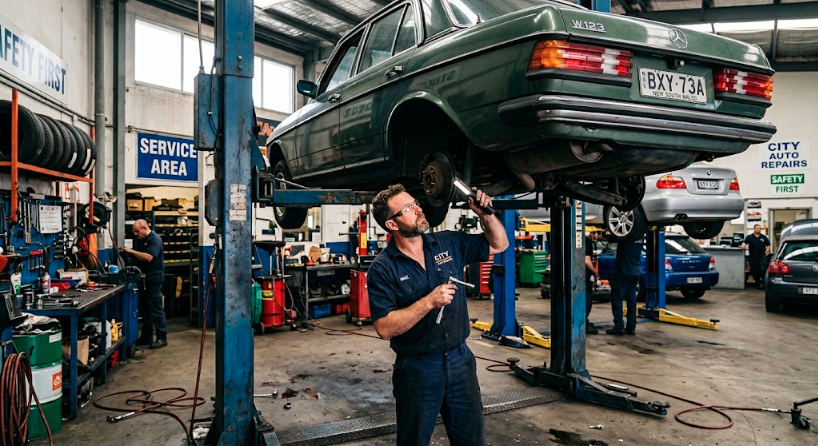
This is the big one. Hoists are the highest-consequence piece of equipment in any workshop. Under Australian Standard AS/NZS 2550.9, hoists must be inspected before use each day by the operator, and inspection and maintenance records must be kept. The standard is specific — pre-operational checks before each shift, routine maintenance on schedule, annual inspections, and a major inspection at the 10-year mark.
An inspector will want to see those records. Not your word that it gets checked every morning. The actual records. If you're still relying on a paper logbook bolted to the hoist, ask yourself honestly: is that book complete, legible, and up to date for every single day?
2. Manual handling — lifting, bending and twisting
Body stressing injuries account for 47% of all workers' compensation claims in motor vehicle workshops. Inspectors look for evidence that manual handling risks have been identified and controls are in place. Do workers know the correct technique for lifting heavy components? Are mechanical aids available and actually used?
3. Noise exposure
Workshop noise regularly exceeds safe exposure standards. Inspectors check whether noise levels have been assessed, whether hearing protection is available, and whether workers are actually using it.
4. Pushing and pulling heavy loads
Tyres, wheels, brake drums — workshops deal with heavy awkward loads constantly. Inspectors look at whether the risks have been assessed and whether appropriate equipment is available.
5. Slips, trips and falls
Oily floors, cluttered walkways, wet bays. Simple hazards that cause real injuries. Inspectors look at housekeeping standards and whether hazard reporting is happening — are spills getting logged and actioned, or just wiped up and forgotten?
6. Tools and machinery
Power tools, grinders, rotating equipment. Are guards in place? Are tools inspected regularly? Is damaged equipment tagged out of service rather than just pushed to the back of the bench?
What "Systematic" Actually Means to an Inspector
Here's the distinction that matters most.
An inspector isn't just looking at whether your workshop is tidy on the day they arrive. They're looking for evidence of a systematic approach — that safety is a routine part of how you operate, not something you scramble to demonstrate when someone official shows up.
That means they want to see:
Regular inspection records — not just recent ones, but a consistent history showing checks happen every day, not just when you remember
Hazard reports and corrective actions — evidence that when something is identified, it gets followed up and closed out
Incident records — even near misses, properly documented
Consistent process across all locations — if you run multiple sites, an inspector expects the same standard everywhere, not just at your best-run location
The difference between a workshop that receives a compliance notice and one that doesn't is usually not the physical state of the workshop. It's the quality of the documentation.
The Consequences of Getting It Wrong
A compliance notice is the least of your worries if something serious happens.
If a worker is seriously injured and WorkSafe investigates, the question they will ask is: what did you do to prevent this? What evidence do you have that you identified this risk, put controls in place, and monitored them systematically?
If your answer is "we always check the hoists, we just don't write it down" — that is not a defensible position under the WHS Act. The PCBU duty requires you to be able to demonstrate your approach, not just assert it.
Prosecutions under the WHS Act carry significant penalties. For a PCBU, the maximum penalty for a Category 1 offence — where reckless conduct causes death or serious injury — is $3 million. Category 2, where there's a failure to comply with a duty that exposes someone to risk, carries up to $1.5 million.
Those numbers are the extreme end. But even at the compliance notice level, the disruption, the prohibition of equipment, the time spent responding — it costs a workshop owner real money and real stress.
The Practical Reality for Workshop Owners
None of this is meant to be frightening for its own sake. The good news is that the bar for demonstrating a systematic approach is not unreasonably high.
WorkSafe inspectors are not trying to catch out workshop owners who are genuinely making the effort. What they're looking for is evidence of genuine effort — and that evidence needs to exist in a form you can actually show them.
Daily hoist pre-start checks, logged and timestamped. Hazard reports that lead to corrective actions, documented and closed out. Incident records that show you take near misses seriously. A consistent process that runs the same way at every location, every day.
If you can show an inspector that, you're in a strong position. If you can't — if your records are scattered, incomplete, or simply don't exist — you're exposed regardless of how conscientious you actually are.
One More Thing Worth Knowing
WorkSafe inspection campaigns in the automotive sector are not slowing down. Hoist safety in particular remains a priority focus area for regulators across multiple states. If your workshop hasn't had a visit yet, that doesn't mean it won't.
The workshops that sail through inspections aren't the ones that got lucky. They're the ones that built systems and stuck to them.
AutoComply360 is workplace safety compliance software built specifically for Australian and New Zealand auto workshops. It gives PCBUs the documented evidence of systematic safety management that WorkSafe inspectors are looking for — daily hoist pre-start checks, hazard registers, incident records and corrective action trails, all timestamped and audit-ready. If a WorkSafe inspector walked in tomorrow, could you show them what they need to see?
Book a demo with someone who actually understands workshops.


Comments